AIFULL STACK
SHERLOCK — REAL-TIME CANDIDATE IDENTIFIER
Jul 2026 - Jul 2026 • WEB APP / API
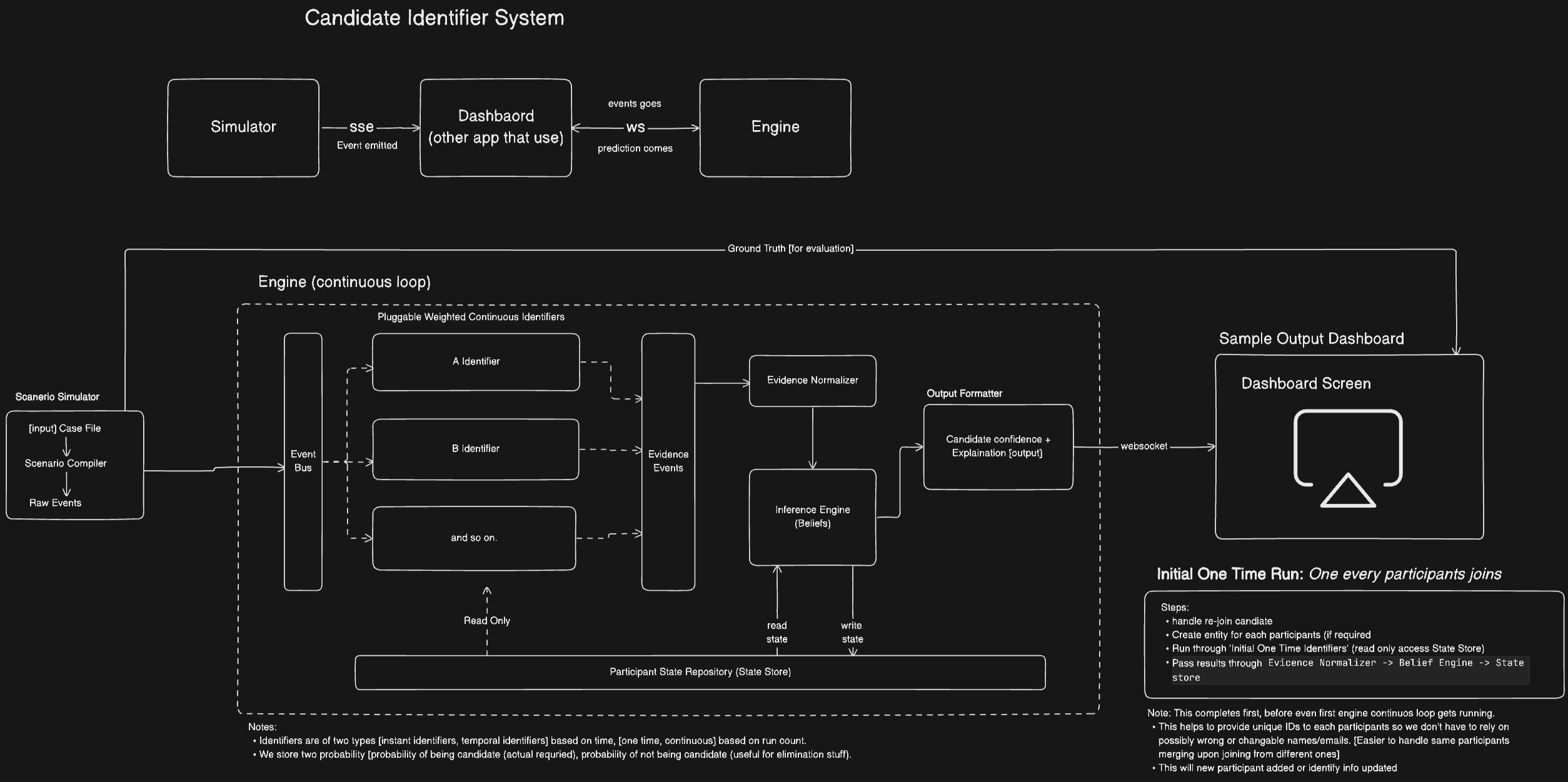
Architecture diagram
Real-time system identifying the actual interview candidate via Bayesian belief across 9 parallel live signals.
THE PROBLEM
Modern hiring platforms can't verify that the person on screen during a video interview is actually the invited candidate — they may join under a pseudonym, a device name, or a mismatched display name. A one-shot name match is trivially defeated; the system needs to reason continuously as new signals arrive throughout the call.
THE RESULT
Built a complete three-service system (simulator, Next.js dashboard, Python inference engine) that runs 9 independent signal extractors in parallel — 7 rule-based and 2 LLM-backed — and maintains a live Bayesian belief over candidate identity, surfacing a real-time verdict with confidence and a per-signal reasoning trail on the dashboard.
HOW IT WORKS
Sherlock treats candidate identification as a continuous probabilistic inference problem rather than a name lookup. The system is split into three services that communicate over WebSocket: a Python scenario simulator, a Next.js relay dashboard, and a Python FastAPI belief engine.
Key technical achievements include:
- Belief Engine: Maintains two independent log-odds tracks per participant —
logit_candidate(converted via softmax across all participants, so probabilities are zero-sum) andlogit_not_candidate(converted via per-participant sigmoid, allowing multiple people to simultaneously be eliminated) — updated on every incoming event. - Per-Identifier Decay: Each identifier's contribution is stored as its own bucket with a configurable
decay_half_life. Decayed values are summed lazily at read time (raw * 0.5^(elapsed / half_life)) so stale evidence fades without a background timer. - 9 Pluggable Identifiers:
name_match,email_identity,host_organizer(rule-based, one-time);speaking_share,qa_pattern,screenshare_heuristic,silent_observer(rule-based, continuous);llm_name_roleandllm_transcript_role(LLM-backed via LiteLLM, fail-open — the engine stays fully functional if the LLM provider is unreachable). - DAG-Ordered Processor Registry: Identifiers are registered in a dependency DAG (Kahn's algorithm); downstream processors are guaranteed to run only after their dependencies have produced output into a shared Feature Cache.
- 5-State Detection Machine:
exploring → searching → likely_candidate → stable_candidate → lost_candidate, with a warmup gate (≥ 20 s elapsed + ≥ 3 evidence pieces) to prevent premature mis-identification, and hysteresis (separate entry/exit thresholds + a streak requirement) to prevent flapping. - Scenario Simulator: Compiles YAML scenario files into a timed event stream (
participant_join,transcript_segment,screenshare_start, etc.) over WebSocket at configurable playback speed; includes 9 authored scenarios covering edge cases like mid-call renames, silent observer farms, and webcam-off sessions. - Next.js Dashboard: Relays the event stream to the engine, displays live transcript, participant tiles, and an engine panel with real-time confidence scores and per-identifier reasoning lines; uses Zustand for session state and Zod for wire-format validation.
TECH STACK
Python 3.12+FastAPILiteLLMuvicornwebsocketspydanticpyyamlNext.js 16React 19TypeScriptTailwind CSS v4ZustandZodshadcn/uiTurborepopnpm
TAGS
Bayesian InferenceLog-Odds AccumulationExponential DecaySoftmaxWebSocketEvent-Driven ArchitectureDAG Dependency OrderingState MachineLLM IntegrationPluggable IdentifiersScenario SimulationYAML Scenario AuthoringZod Schema ValidationZustandServer-Sent Events